|
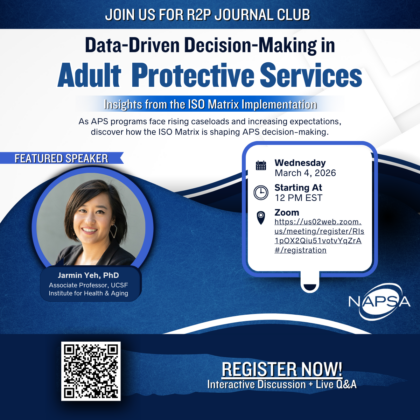
As Adult Protective Services programs navigate rising caseloads, increasing complexity, and growing expectations for measurable outcomes, many agencies are shifting toward more structured, data-driven practices such as the use of formal assessment protocols. But what does this change look like in real-world APS practice?
Join us for an engaging conversation exploring the implementation of the Identification, Services, and Outcomes (ISO) Matrix — and what it means for APS professionals working on the frontlines.
About this Webinar
In this interactive session, Dr. Jarmin Yeh will share insights from a recent study (with co-authors Marian Liu and Rebecca Park) examining how APS professionals experience the shift toward standardized, data-driven practices such as the ISO Matrix.
As APS programs strive for greater consistency, transparency, and analytic rigor, the use of structured tools bring both promise and challenges — especially within a human-centered, high-stakes field. Drawing from focus groups with APS caseworkers and supervisors, this discussion will explore:
- How data-driven tools help APS workers demonstrate the value of their work
- Workforce perspectives on implementing the ISO given the complexity of real-life cases
- Strategies for balancing technological innovations with the need to maintain strong human relationships
Featured Speaker
Jarmin Yeh, PhD – Associate Professor, University of California, San Francisco (UCSF) Institute for Health & Aging, School of Nursing
Dr. Yeh is a sociologist and gerontologist whose research focuses on age-friendly communities, age-friendly health systems, and workforce issues impacting older adults, people living with dementia, and caregivers. She directs the Community Action Research in Gerontology (CARING) Lab and co-directs the UCSF Emancipatory Sciences Lab.
Participants will have the opportunity to engage directly with the authors, ask questions, and reflect on how APS programs can implement structured tools in ways that strengthen both workforce support and elder justice outcomes.
Whether you’re an APS professional, researcher, administrator, or policymaker, this conversation will provide valuable insight into the future of data-informed APS practice.
|